Capacity at Its Finest
"Once they actually started to make room, it gets immediately taken by the next 'thing' in line. "

We covet the email calendar and getting that sacred free time to tackle the backlog, only to watch it get whisked away the moment it appears. Capacity has been a hot topic, with several clients having very similar issues. Once they actually started to make room, it gets immediately taken by the next "thing" in line.
One of them had just started applying the plan we created, delegation through handing over day to day support rhythm to the tenured person on the team, declining meetings without agendas, setting clear boundaries. The plan was to reclaim two hours a week that they currently didn't have, and there was a clear intention how to use it, finishing up a self-paced portion of a training they started at the beginning of the year, and putting the path back on track to clear the long unfinished work completed by the winter.
Then, their company stood up a new AI working group and proudly attached one of their front running adopters to it.
Those two hours of designated free space actually existed for this leader who has only been able to answer emails before and after working hours for over a year, and something else got to it first.
It's very common for you and the people who support your growth to acknowledge that training and development is important... sitting firmly in that high priority non-urgent square in our Eisenhower matrix.
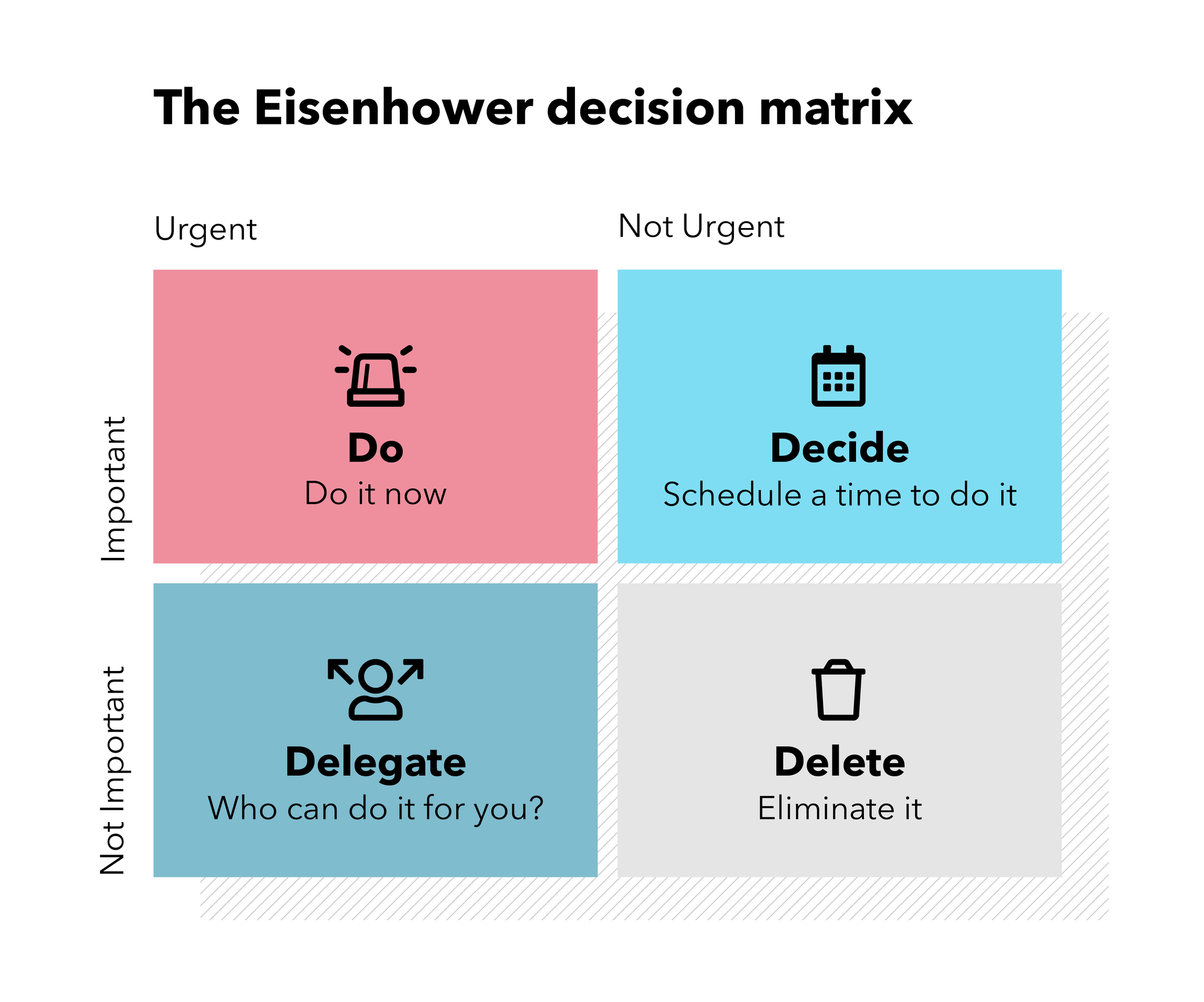
What we landed on in the session? Treating capacity as the outcome was a red herring. You probably have seen this in one of two ways: nature abhors a vacuum or Parkinson's Law, the time it takes to complete a task expands or contracts to the space given.
The initial reaction from the client is to ask their superior what to do, or where they should focus on. There's nothing necessarily wrong with that, but we didn't we just run that play before? Fool me twice. I ended up challenging the client to go the other way. Walk in with a recommendation in hand, with an educated guess on the time it takes, the trade-off's, and what would need to move/change to go in that direction. That way, the client can bring the problem to solve, rather than having someone else decide what question to ask.
I could see it both in their eyes, and complexion that this was clicking as a stronger path, as the wheels were turning before I even finished sharing my challenge (without attachment, in true coaching fashion).
Traffic Signs
Some of the news and content I've been consuming related to the spaces I work in... Learning & Development, HR/People Ops, Leadership, OD, and Professional Coaching.
Verizon CEO Dan Schulman on culture before strategy
- Podcast - HBR IdeaCast
- Putting aside the face that Dan Schulman's call back to Verizon echo's a frequent Star Trek story trope, his discussion on legacy culture vs current culture has a lot chew on. After years of losing the brand and market corner that Verizon was known for, Schulman acknowledges the current state of things in slideless all-hands meetings, being very transparent about the upcoming RIF (reduction in force) as a response.
- Verizon is also heavily investing in AI reskilling, and backs that up with the increase in budget being dedicated. He said $20 million, which sounds like a lot, but they have around 89,000 people, and that money is not even .015% of their annual revenue. L&D folks know the game of being given the task without the funding to make the miracles happen.
- The roadmap he paints is culture in year one, and AI-native skillsets around year three, while reducing their spend by $5 billion. It will be very curious to see how closely Verizon sticks to all of that.
- I would love to talk to anyone who can share about what AI-native L&D is shaping up to be over there. If you know someone, drop me a line: crossstreetcoaching@gmail.com
How's that AI Layoff going for you?
- Article - Fast Company - The great AI layoff is turning into the great AI rehire," Dan Schawbel, 15 July 2026
- To the surprise of no one, the early signs of the impact of AI related rash of layoffs is now starting to solidify. Those of us in the People and Talent space have already seen what mergers and RIFs can do to a great culture, and the Fast Company article acknowledges that this hasty market response isn't new. It's also still happening, even if the real reason isn't AI.
- The tl;dr version is that they have to buy talent back at a higher rate and expense than if they kept them. I'll personally pass on whatever Great Something moniker this phase of recruiting is. The last ones weren't that great either.
- They also list some companies, including IBM, a pioneer in the AI space if y'all remember, is tripling its entry-level Gen Z hiring rather than cutting it. Ikea shifted 8k of their customer service employees to interior design. They're correctly surmising if entry-level roles are where organizational knowledge gets built, and that today's high performers are running on tacit or implicit knowledge they gained while in those roles. Move all of it to AI and you're left with nothing and no one to do the work a few years out. Oof, talent drought, major bummer.
- Since the flagship AI companies aren't profitable yet, one only needs to look at how Uber, Lyft, or Airbnb started. Quirky and innovative low-cost alternatives to long standing infrastructure is great... until they become the thing they swore to defend against. The price on premium model AI functionality and compute is going to have ratchet up too.
Debunking the classroom solution
- Post - Linkedin - Ross Stevenson
- I've been following Ross and his newsletter Steal These Thoughts! for a year or so now, and he always has great insights on putting digestible perspective on L&D as a discipline and a business function, rather than the traditional non-revenue lens.
- In his video post, he explains the desire to simplify the problem and what appears to be a simple solution. The problems sometimes are more performance based, which rarely are fixable with a single solution point.
- My take on this also falls into what happens after even long engagements and programs. If you stick people back into the same environment that created the problem, with no modification to what created it in the first place. Well, ya know, don't be surprised.
These are the questions I'm sitting with this week:
- How are you spending your time?
- What are you really saying when you tell other people how busy you are?
- What's allowing your free time or capacity you create to get eaten up by something or someone else?
That's all for this dispatch, until next time!